What does a modern tiffin service business look like in 2026?
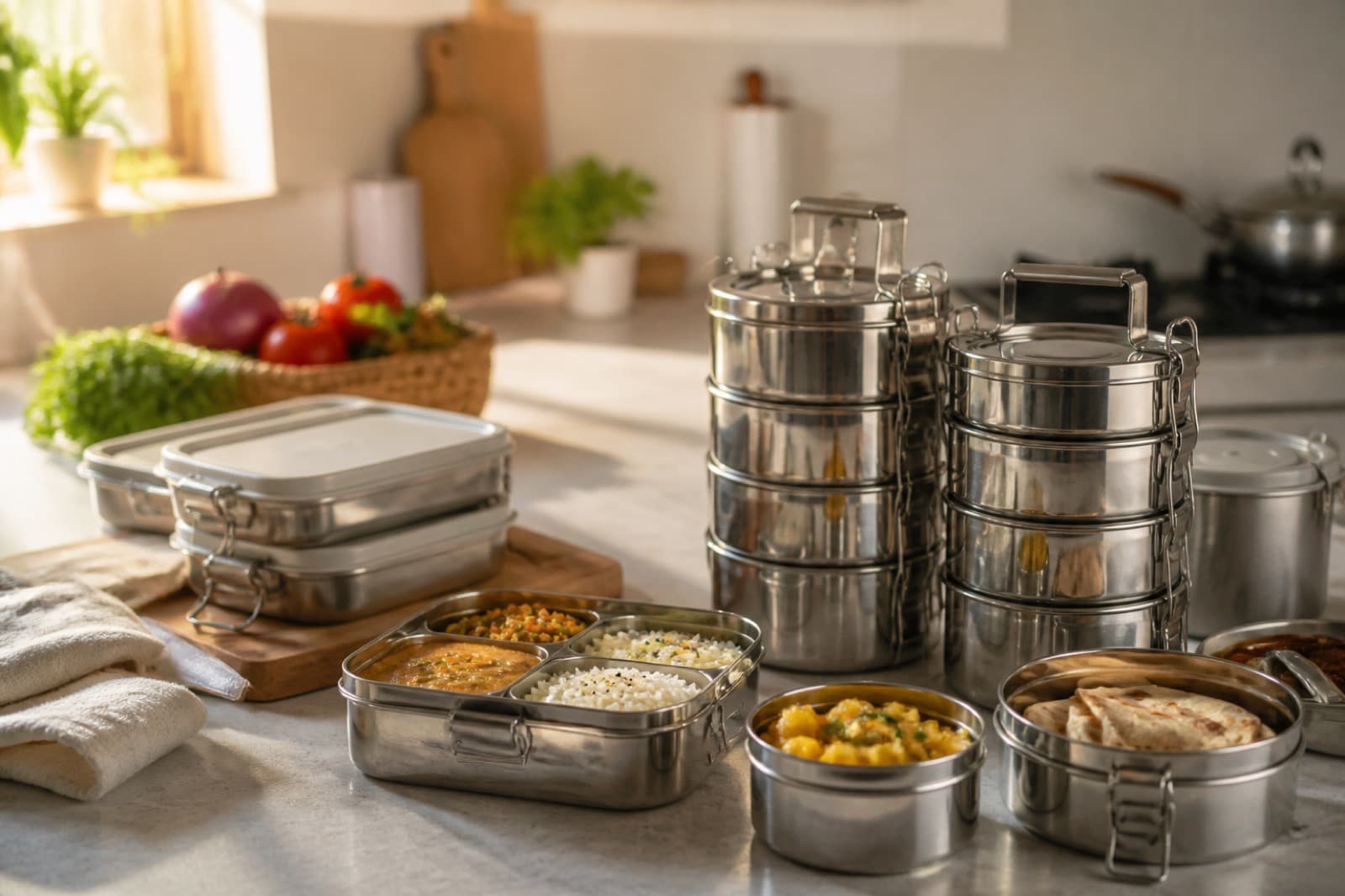
If you want to start a tiffin service business India founders actually run in 2026, think subscription kitchen—not a one-off dabba chat. A modern homemade tiffin business sells breakfast, lunch, and dinner plans on a monthly (or weekly) cycle, delivers to PGs, offices, and apartments, and lets customers pause, resume, or skip when they travel. The kitchen cooks to a confirmed list. Billing is clean. Delivery staff work from one shared run sheet—not three WhatsApp forwards.
That model works especially well in Indian metros such as Mumbai, Delhi NCR, Bangalore, Hyderabad, and Pune, where working professionals and students pay for home-style food on a predictable cadence. You do not need a dine-in cafe. You need consistent food, a repeatable menu, a compliance baseline, and an operations stack that survives after 30 customers.
One branding note so searchers do not mix products: TasteIQ (tasteiq.in) is software for founders launching their own online tiffin brand. TasteIQ Foods (foods.tasteiq.in) is a separate consumer meal service limited to selected Bengaluru PIN codes. This guide is only about building your tiffin subscription business.
How much does it cost to start a tiffin service from home?
Startup cost depends on whether you launch from a home kitchen, a rented cloud kitchen, or a small commercial unit. Treat these as planning bands for metro India—not quotes.
| Launch path | Typical startup band | What it usually covers |
| --- | --- | --- |
| Home kitchen (owner-operated) | ₹40,000 – ₹2.5 lakh | Utensils, insulated bags, packaging, basic fridge/freezer, first-month groceries, local marketing |
| Shared / cloud kitchen slot | ₹1.5 – ₹6 lakh | Slot deposit, equipment share, utilities buffer, packaging station, 1–2 months runway |
| Small dedicated kitchen | ₹4 – ₹12 lakh | Rent deposit, fit-out, commercial burners, cold storage, pest control setup, working capital |
Hidden costs that trip first-time founders:
- Working capital: 15–30 days of ingredients before subscription money settles reliably.
- Packaging: containers, seals, labels, and insulated bags for rainy-season routes.
- Delivery: own scooter fuel and staff wages, or per-order fees to third-party delivery staff.
- Compliance buffer: FSSAI application fees, basic hygiene upgrades, and GST setup if you register early.
A homemade tiffin business can start lean. The risk is not the stove—it is running operations on memory after demand grows. Plan capital for food quality and for systems that keep pause/skip requests from breaking tomorrow’s prep list.
What licenses do you need (FSSAI and beyond)?
Any food business selling to the public in India needs food-safety registration through FSSAI. Home cooks are not exempt once they sell commercially. Apply through the official FoSCoS portal and follow current category rules on FSSAI.
Practical sequencing for a first-time operator:
- Decide the legal entity (sole prop, partnership, or Pvt Ltd) with a CA.
- Apply for the correct FSSAI category for your turnover and premises type on FoSCoS.
- Display the 14-digit FSSAI number on packaging, invoices, and your ordering website once issued.
- Check GST registration thresholds with your CA—metro volume often crosses them quickly.
- Confirm city-level Shop & Establishment / trade requirements where your kitchen is registered.
TasteIQ can assist with document readiness and process navigation for founders who want help—but TasteIQ does not issue FSSAI licenses, does not approve applications, and cannot guarantee timelines or outcomes. Licensing decisions rest with FSSAI and local authorities. For a deeper walkthrough of food-business licensing context, see our FSSAI license page and related India compliance guides.
Do not wait until you have 50 customers to start paperwork. Getting the number onto invoices and packaging early builds trust with offices, PGs, and apartment groups.
How should you design the menu and price meals?
A monthly tiffin subscription business wins on consistency, not on a 40-item restaurant menu. Launch with a tight rotation:
- Breakfast: 4–6 rotating items (upma, poha, paratha + sabzi, idli/dosa sets, eggs where demand exists).
- Lunch / dinner: dal + sabzi + roti/rice as the default, with 1–2 premium variants (paneer, chicken, fish) priced higher.
- Weekly planner: publish a simple 7-day board customers can trust.
Directional metro pricing many founders use for planning (not a promise of what your market will pay):
| Meal type | Common planning range (per meal) | Notes |
| --- | --- | --- |
| Veg lunch / dinner | ₹70 – ₹100 | Volume plans; keep portions honest |
| Non-veg / premium veg | ₹90 – ₹120 | Clear differentiation on protein |
| Breakfast | ₹50 – ₹80 | Often sold as add-on to B/L/D plans |
Price from recipe cost, not from a neighbour’s WhatsApp rate. Track raw material cost per meal, packaging, fuel or delivery fee, and a buffer for skips and wastage. Then set monthly plan prices so weekly cash covers groceries before you scale marketing.
Offer breakfast, lunch, and dinner as separate or bundled plans. Let customers pause when they travel and skip a day when plans change—those two features alone prevent most “you charged me for days I was out of town” fights.
How do you find your first 10–30 customers?
Do not start with a national ads budget. Start with density.
- Personal network: colleagues, housing society groups, alumni WhatsApp communities.
- Hyperlocal PGs and offices: one building with 20 subscribers beats 20 scattered pin codes.
- Sample days: sell a 3-day trial pack before locking a monthly plan.
- Referral loop: one free meal credit for every successful referral after the second week.
- Clear promise: same delivery window, labelled containers, pause/skip rules written once.
In Bangalore IT corridors, Hyderabad HITEC/Gachibowli belts, Pune Hinjewadi/Kharadi, Mumbai western suburbs, and Delhi NCR office clusters, the pattern is the same: founders who cluster routes retain customers; founders who accept every distant pin code burn fuel and time.
Your first 10 customers teach recipe yield. Your next 20 teach delivery timing. Only after that should you widen geography.
When should you move from WhatsApp to software?
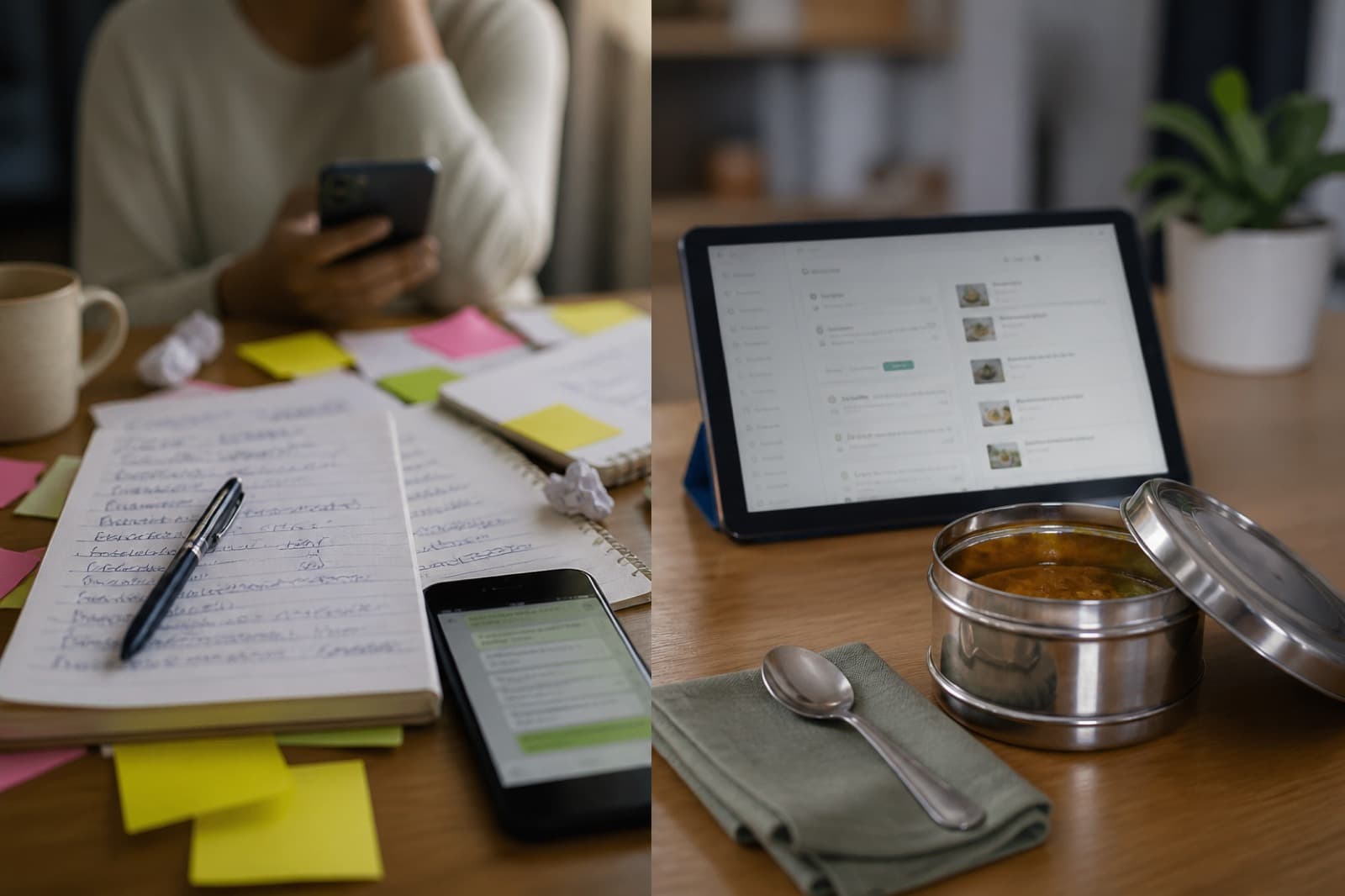
WhatsApp + UPI is a fine acquisition channel. It is a fragile operating system.
Early symptoms you have outgrown chat:
- Two notebooks disagree on who paused lunch.
- Delivery staff ask which bags are for which tower.
- You lose track of who paid for which week.
- Kitchen cooks for people who already skipped.
That is the moment to digitise—not after chaos peaks. A proper stack for a tiffin service business plan India founders can execute looks like this:
- Branded website + ordering app (PWA) so customers subscribe from a link.
- B/L/D plans with pause, resume, and skip.
- One daily list for own fleet or third-party delivery staff.
- Kitchen tickets with KOT lineage so prep matches confirmed orders.
- GST-ready billing instead of month-end spreadsheet archaeology.
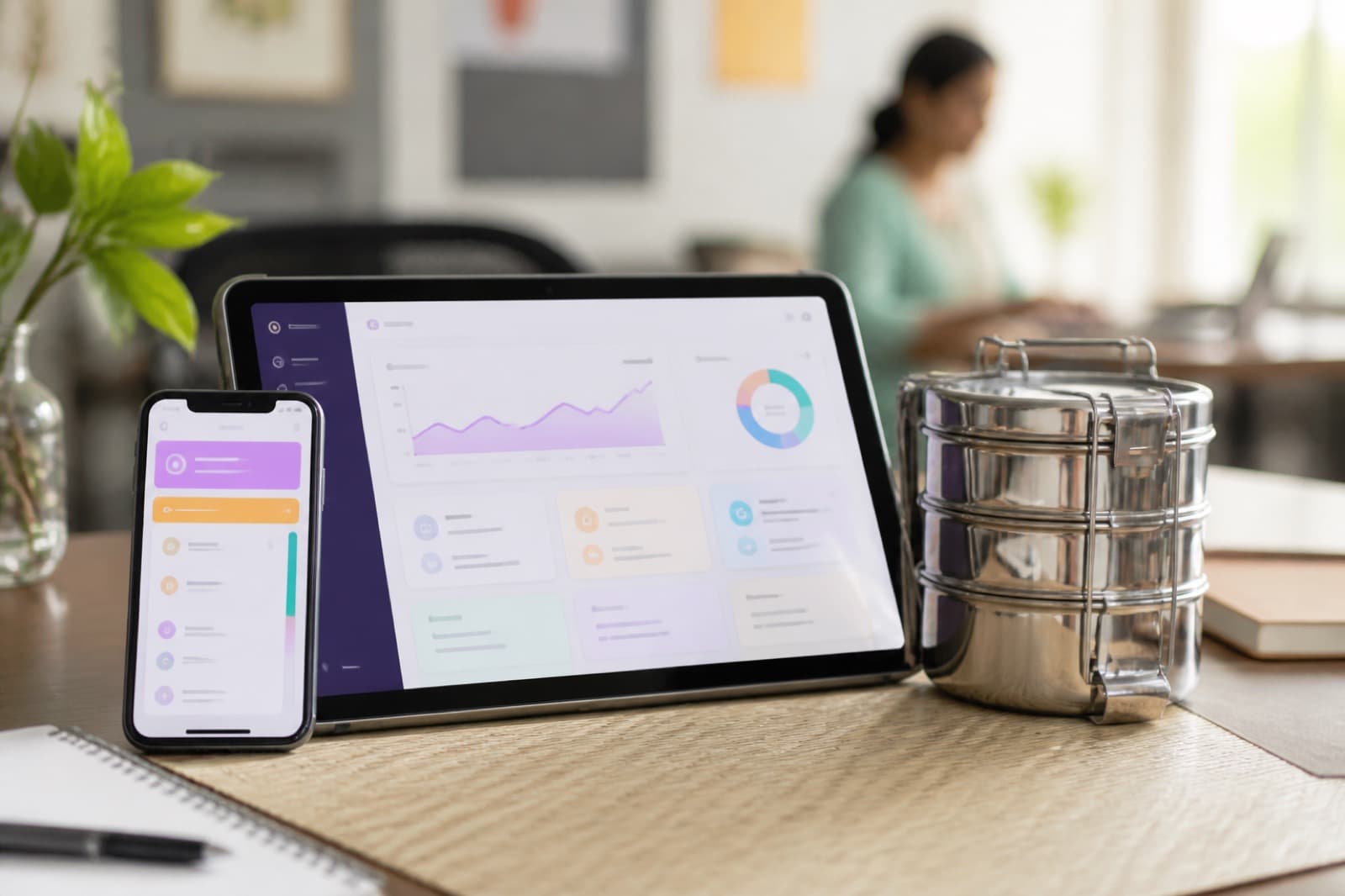
TasteIQ is built exactly for that transition: founders typically go live in about 15 minutes from menu photos, with a 14-day free trial. Customers keep the WhatsApp relationship; operations move to a single source of truth. Explore the product on the tiffin launch page, or compare broader food-business tooling on restaurant POS software.
Should you use your own delivery fleet or third-party staff?
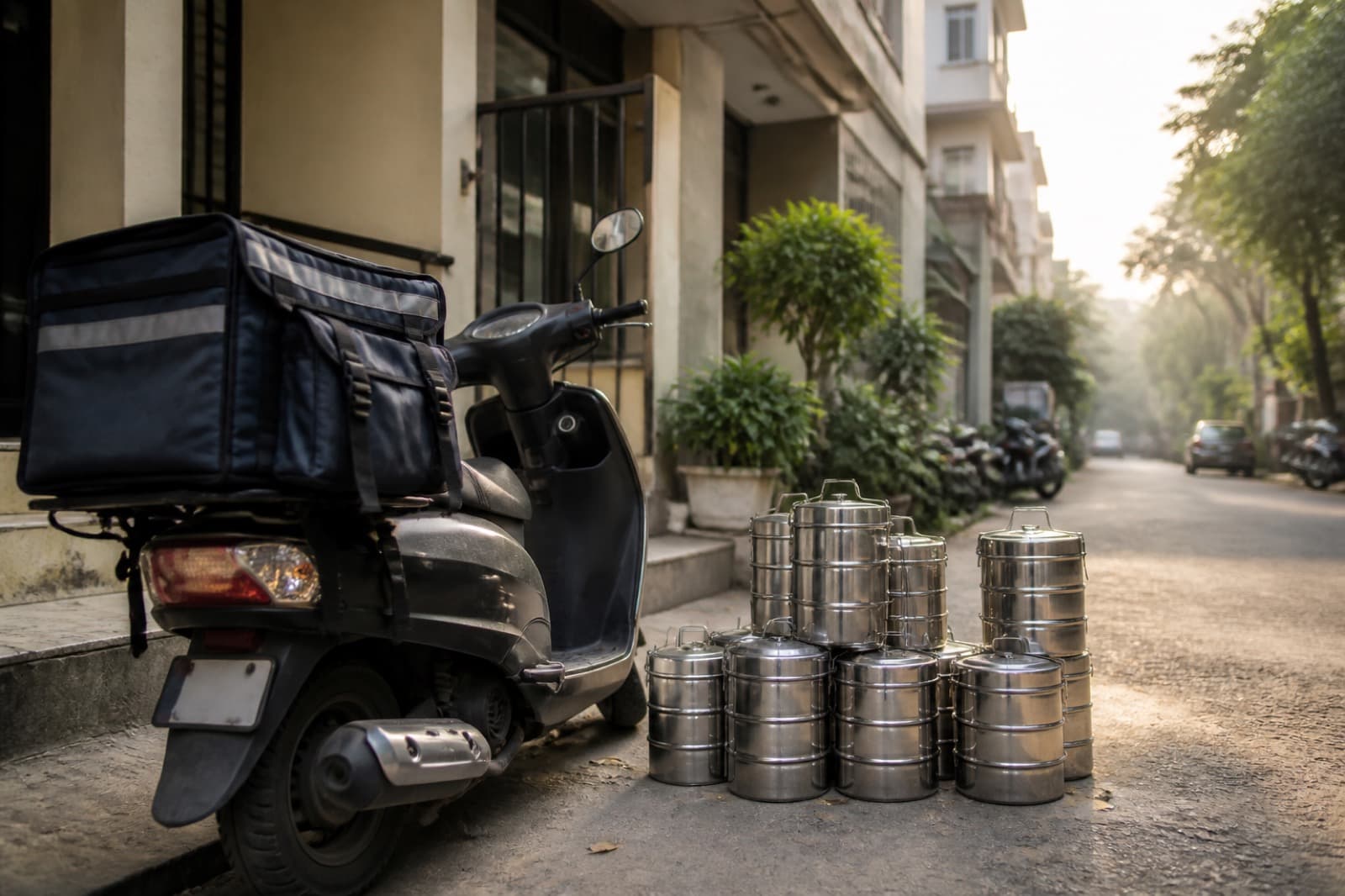
Delivery is a route problem, not a branding problem.
Own fleet fits when:
- Most customers sit inside a tight radius (often 3–6 km at launch).
- You can hire reliable riders for fixed windows.
- Brand control and food temperature matter more than variable cost.
Third-party delivery staff fit when:
- Volume spikes on weekdays and dips on weekends.
- You want to avoid full-time rider payroll early.
- You still need one packing list—not a second ops app.
Many kitchens mix both: own riders for dense societies, third-party staff for overflow. What matters is that both work from the same daily list. Splitting “WhatsApp list for Ramesh” and “Excel for the agency” recreates the exact errors software is meant to remove.
What systems checklist should you complete before scaling past 30 customers?
Use this as a go-live checklist for a monthly tiffin subscription business:
| Area | Ready when… |
| --- | --- |
| Menu | 7-day rotation published; recipe costs known |
| Compliance | FSSAI application filed or number live; packaging labelled |
| Pricing | Plan prices cover food + packaging + delivery + buffer |
| Customers | First 10–30 clustered by route, not scattered citywide |
| Orders | Pause / resume / skip rules written and enforced in software |
| Kitchen | Prep list generated from confirmed subscriptions (KOT lineage) |
| Delivery | Own or third-party staff assigned from one list |
| Billing | GST-ready invoices; UPI/chat collection reconciled weekly |
| Brand site | Website + PWA link shared instead of only personal chat |
If any row is still “in my head,” pause acquisition and fix the system. Growth without ops discipline creates refunds, cold food, and public complaints in society groups—harder to reverse than a slow start.
Ready to launch your online tiffin brand?
You now have the practical path: cost bands, FSSAI basics, menu and ₹70–120 directional pricing, first customers via WhatsApp density, then a clean jump into subscription software with delivery choice and kitchen discipline.
TasteIQ gives founders a branded website, ordering app (PWA), breakfast/lunch/dinner plans with pause/resume/skip, own-fleet or third-party delivery on the same list, KOT-lineage kitchen flow, and GST-ready billing—so you run a real business, not a chat archive.
Start your 14-day free trial · live in ~15 minutes
- Sign up: https://partners.tasteiq.in/signup
- See the tiffin product: /tiffin
Build the kitchen you are proud of. Let software hold the subscriptions, skips, and delivery list so you can cook.