Why “WhatsApp + notebook” breaks after ~30–50 subscribers
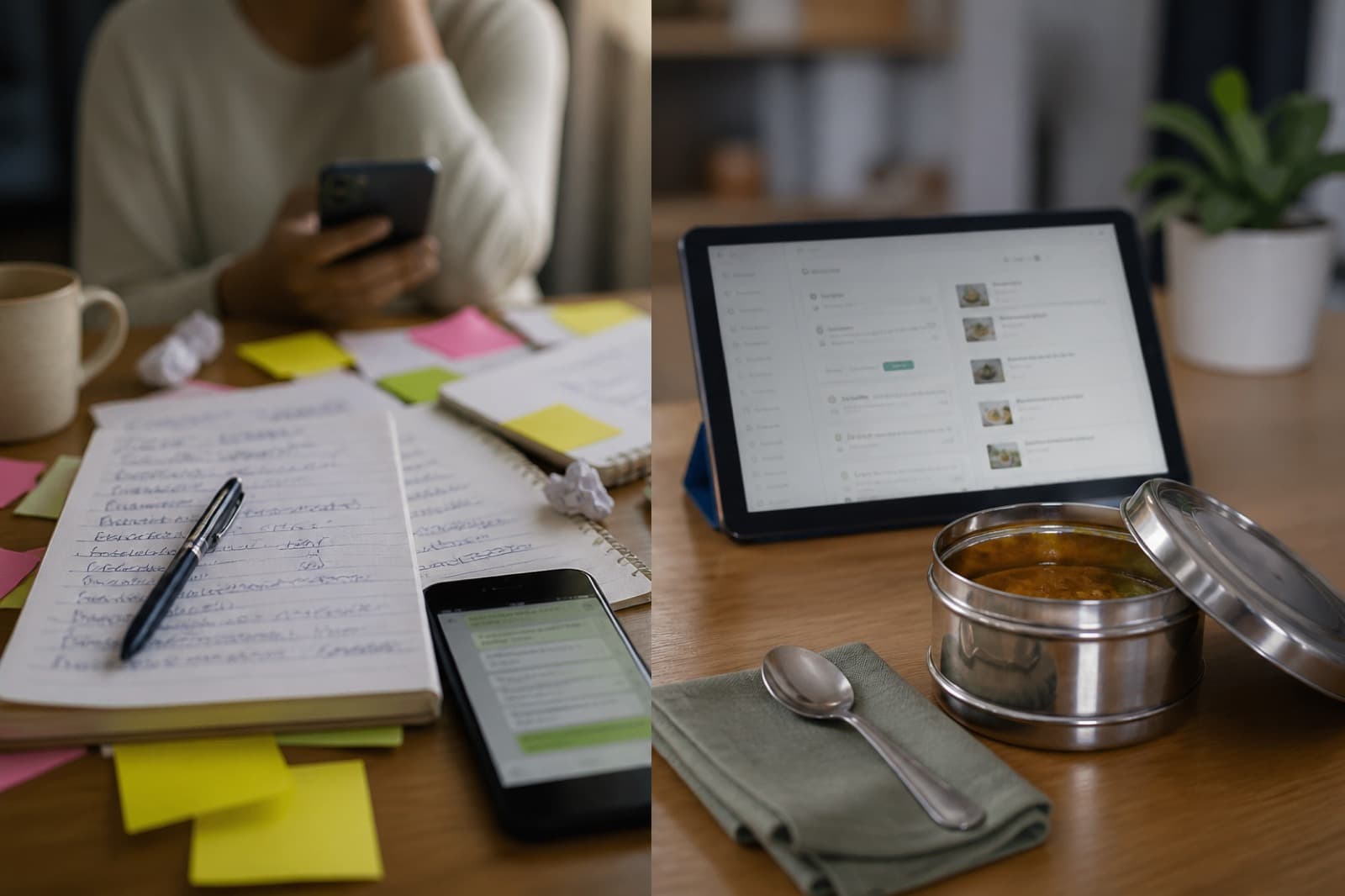
Most tiffin businesses in India start the same way: a WhatsApp broadcast list, UPI screenshots, and a ruled notebook for who eats breakfast, lunch, or dinner. That setup works when you know every customer by name. It fails when volume forces you to run a real subscription operation.
Around 30–50 active subscribers, three problems usually show up together:
- Plan changes stop being chats and start being disputes. Someone travels for a week, someone skips Thursday dinner, someone claims they already paused. Without a shared system of record, every change becomes a message thread you have to reconstruct later.
- Prep becomes guesswork. The kitchen needs a clean daily count—not a mental merge of last night’s notes, this morning’s voice notes, and a half-updated Excel sheet. Over-cooking wastes food cost. Under-cooking creates refunds and trust damage.
- Money and delivery drift apart. Collections live in UPI history. Delivery lists live in a rider’s phone. Invoices live nowhere. Month-end becomes archaeology instead of accounting.
That is the commercial moment buyers start searching for tiffin subscription software. They are not looking for another messaging app. They are looking for software that treats meal plans as products customers can manage—and that kitchen and delivery teams can execute without arguing about yesterday’s chat.
If you are evaluating tools, start from the business model itself. A tiffin subscription is not a one-off restaurant order. It is recurring fulfillment with pause, resume, skip, and route-level delivery. Generic restaurant POS helps with tickets and billing; meal subscription workflows need more than that. TasteIQ’s tiffin launcher is built around that subscription loop rather than dine-in table service alone.
What “tiffin subscription software” should actually mean
When buyers compare tiffin management software or a tiffin service app in India, feature pages often look similar. The useful filter is operational: does the product reduce daily exceptions, or does it only digitize the signup form?
A serious system for Indian tiffin operators should cover five layers:
| Layer | What buyers need | Why it matters past ~50 subscribers |
| --- | --- | --- |
| Customer storefront | Branded website + mobile ordering (often PWA) | Customers subscribe without App Store friction or random WhatsApp links |
| Plan engine | Breakfast / lunch / dinner plans with pause, resume, skip | Plan exceptions become self-serve instead of admin work |
| Kitchen ops | Daily prep list + KOT-style kitchen view | Cook for who will actually eat today |
| Delivery ops | Own fleet or third-party delivery staff assignment | One packing list, clear rider ownership |
| Money & compliance | GST-ready invoices | Food business billing that survives scrutiny |
If a vendor cannot explain how pause/resume/skip updates tomorrow’s prep and delivery list, it is not meal subscription software yet—it is a brochure site with a payment button.
Must-have features: a buyer checklist
Use this checklist when you shortlist tools. Score each vendor honestly. A “nice UI” does not replace missing subscription controls.
| Must-have | What good looks like | Red flag |
| --- | --- | --- |
| Branded website + app | Customers browse plans and subscribe under your brand; mobile experience works as a PWA without forcing an App Store install | Only Instagram bio links or WhatsApp catalog checkout |
| B / L / D plans | Breakfast, lunch, and dinner can be sold as separate or bundled subscriptions | One flat “meal pack” with no meal-slot logic |
| Pause / resume / skip | Customer can pause travel days, resume later, and skip a single day without cancelling the month | Admin must edit a ledger for every village trip |
| Daily prep list | Kitchen sees who is active for each slot after skips and pauses | Prep still rebuilt from chats every morning |
| Delivery assignment | Assign own riders or third-party delivery staff to the same day’s orders | Delivery list copied into a separate spreadsheet |
| KOT / kitchen tickets | Orders flow into a kitchen view the team can execute | Kitchen relies on screenshots |
| GST invoices | Food-business billing you can issue without rebuilding books at month-end | Only UPI screenshots and informal receipts |
| Fast setup + trial | Roughly 15-minute setup from menu photos; 14-day trial to validate with real customers | Long implementation before you can test one route |
Pause, resume, and skip are not “nice-to-haves”
For Indian tiffin buyers, pause resume tiffin plan behavior is often the purchase trigger. Subscribers travel, work from home, host relatives, or skip a festival day. If your software cannot absorb those exceptions cleanly, customer support becomes the product—and your margins shrink.
What operators need in practice:
- Pause when the customer leaves town, without rewriting the whole month by hand.
- Resume onto the next delivery window when they return.
- Skip days for one-off absences without cancelling the subscription.
The kitchen benefit is as important as the customer benefit: the daily prep list should update automatically so you cook for people who will actually eat.
How to evaluate vendors without getting lost in demos
Commercial investigation should be boring and specific. Ask every vendor the same questions and record answers side by side.
1. Map your real workflow, not their demo script
Bring one messy week from your notebook:
- How many subscribers pause mid-cycle?
- How many skip single days?
- Do you run own riders, third-party delivery staff, or both?
- Do you need GST invoices for offices, PGs, or corporate reimbursement?
Ask the vendor to configure your plan structure live. If the demo only works with their sample “Healthy Lunch Plan,” you still do not know whether the software fits.
2. Stress-test exception handling
Ask: “A subscriber pauses Friday through Monday, skips Wednesday dinner, and resumes Tuesday breakfast. Show me what the kitchen prep list and rider list look like on each day.”
That one scenario separates meal subscription software India buyers actually need from generic ordering apps.
3. Check brand ownership
You are building a tiffin brand, not a chat list. Confirm customers get a branded website and mobile ordering experience under your name. A PWA-style app experience is usually enough for subscription ordering without App Store delays or listing fees.
4. Separate delivery model from software lock-in
Some kitchens keep a small own fleet for nearby societies. Others hand packed dabbas to third-party delivery staff as volume grows. Your software should support both without forcing a rewrite of operations. TasteIQ is designed so the same daily list can be assigned to own riders or external delivery staff.
5. Treat billing as part of ops, not an afterthought
If you are registered as a food business, GST-ready invoices matter. Informal UPI proof does not scale when office customers, landlords, or accountants ask for proper bills. Pair software choice with basic compliance hygiene through channels such as GST portal guidance and food licensing via FSSAI FoSCoS where applicable.
6. Demand a trial that proves kitchen reality
A 14-day trial is only useful if you run real pauses, real skips, and at least one full delivery day. Fancy screenshots are not evidence. TasteIQ’s trial is built for that validation loop: configure plans, share your link, and see whether prep and delivery stay calm when exceptions arrive.
How category peers typically differ (without the hype war)
The Indian market for tiffin tools is a mix of:
- WhatsApp-first operators who stay manual until exceptions explode
- Generic restaurant POS vendors that are strong on dine-in billing and KOT but weaker on subscription pause/skip logic
- Niche tiffin or meal-plan apps that focus on subscriptions but may be lighter on kitchen/delivery depth
- Custom-built stacks (website + sheets + accounting tools) that work until the founder becomes the integration layer
None of those paths is “wrong” at 10 subscribers. The comparison changes when recurrence, exceptions, and multi-slot plans become the core product. Fair evaluation means asking which system reduces your morning chaos—not which homepage claims the loudest ranking.
Where TasteIQ fits for tiffin founders
TasteIQ is hospitality software for launching and running an online tiffin subscription business—home cooks, cloud kitchens, and tiffin vendors who want customers to subscribe under their own brand.
What TasteIQ includes for this use case:
- Branded website + app (PWA) for plan browsing and ordering
- Breakfast / lunch / dinner subscription plans
- Built-in pause, resume, and skip
- Own fleet or third-party delivery staff assignment from one daily list
- KOT-style kitchen order flow
- GST-ready billing for a food business
- Roughly 15-minute setup from menu photos
- 14-day free trial before you commit
TasteIQ is a practical fit when you have outgrown WhatsApp notebooks and want subscription control, kitchen clarity, and delivery assignment in one place—without inventing a custom stack.
Mid-funnel next step: start your 14-day trial or review the full tiffin product page to see pause/resume plans, delivery options, and GST billing in context.
A simple shortlist scorecard (use this in vendor calls)
Give each vendor 0–2 points per row (0 = missing, 1 = partial, 2 = clear). Anything under ~10 usually means you will keep running exceptions in WhatsApp.
| Criterion | Score 0–2 | Notes from demo |
| --- | --- | --- |
| Branded website + mobile ordering | | |
| B/L/D plan structure | | |
| Pause / resume / skip updates prep automatically | | |
| Daily prep list is trustworthy | | |
| Own fleet + third-party staff assignment | | |
| Kitchen tickets / KOT flow | | |
| GST invoices | | |
| Trial you can run with real customers this week | | |
If two tools score similarly on features, prefer the one that gets a real route live faster. Implementation delay is a hidden cost in tiffin businesses because every week of chaos teaches customers that exceptions “belong on WhatsApp.”
Common buying mistakes
- Buying a pretty storefront without exception logic. Beautiful menus still fail when pause requests arrive.
- Assuming dine-in POS equals meal subscription software. Tickets and GST help, but skip/pause and prep sync are the subscription core.
- Ignoring delivery ownership. Software that cannot assign riders—own or third-party—pushes logistics back into personal chats.
- Skipping the trial. If you cannot simulate a messy week in 14 days, you will discover gaps after customers are already onboarded.
- Overbuilding custom software too early. Many kitchens only need a focused tiffin stack, not a six-month engineering project.
Bottom line for buyers comparing tools
Choose tiffin subscription software when WhatsApp and notebooks start creating disputes, prep errors, and billing gaps. Prioritize pause/resume/skip, branded ordering, daily prep truth, delivery assignment, KOT, and GST invoices. Evaluate vendors with your real exception scenarios, not their happy-path demo.
If that checklist matches what you need, start a 14-day TasteIQ trial and walk through the tiffin launcher to confirm the workflow before you commit.